
INITIALIZING ARCHITECTURE0%
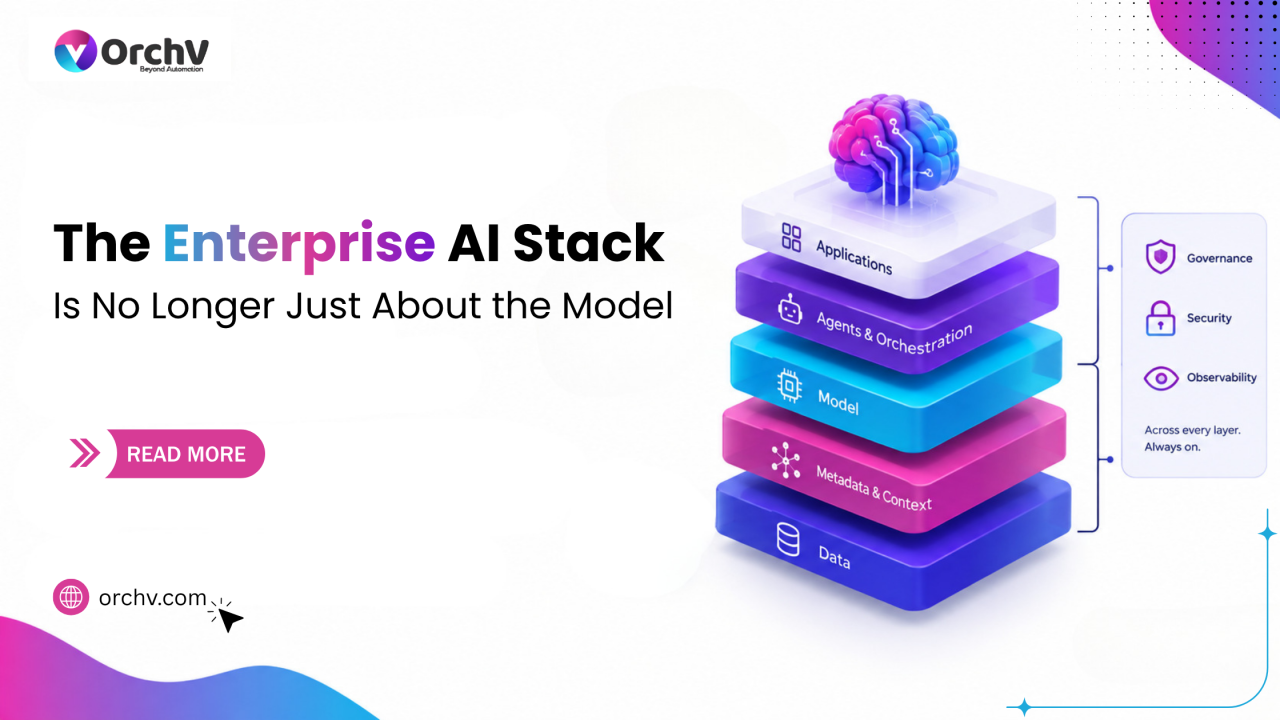
For the past few years, enterprise AI conversations have circled one question: which model should we use? GPT, Claude, Gemini, and a growing field of open-source and specialized models have made it feel like the model is the whole decision. It isn't.
Enterprises are finding that out the hard way. The model is one component in a much larger system. The real work is building an environment where the data is trustworthy, the context is relevant, the agents are controlled, the applications are integrated, and every action can be traced back to something. Enterprise AI is becoming a stack. It stopped being a single model a while ago.
The model isn't the product The gap between AI experimentation and actual business value is what makes this obvious. Evidence from MIT, Gartner, McKinsey, Deloitte, and IDC points to the same pattern: enterprise AI initiatives stall because of data readiness, governance, security, observability, and integration problems, not because someone picked the wrong model.
Deloitte's 2025 State of Generative AI report found that more than two-thirds of respondents expected 30% or fewer of their GenAI experiments to be fully scaled within the following three to six months. Organizational change, risk management, and scaling were the challenges the report kept coming back to.
McKinsey's 2025 global survey tells a similar story from a different angle. 78% of respondents said their organizations were using AI in at least one business function. But the organizations actually capturing value were the ones redesigning workflows and tightening governance, not the ones with the newest model.
AI adoption is outrunning AI operational maturity. That's the whole problem in one sentence.
The new enterprise AI architecture A more useful way to think about enterprise AI is as a layered architecture:
Data → Metadata & Context → Model → Agents & Orchestration → Applications with governance, security, and observability running across every layer rather than sitting at the end of it.
Data: the foundation Every AI system is limited by the information it can actually use. Enterprise data lives across CRMs, ERPs, databases, documents, emails, APIs, warehouses, and whatever legacy system nobody has migrated off yet. When that data is incomplete, outdated, duplicated, or ungoverned, even a very good model produces unreliable output. Data quality, lineage, classification, and access control aren't IT housekeeping anymore. They're AI infrastructure.
Metadata and context: making data understandable The next layer is context. AI systems don't just need raw data, they need to know what it means, where it came from, who's allowed to see it, how current it is, and how it connects to everything else. This is where data catalogs, semantic layers, knowledge graphs, and RAG architectures come in.
The rise of "context engineering" reflects this shift. It's less about writing a clever prompt and more about assembling the right information, memory, and tools for an AI system at each step it takes. It's one of the fastest-moving layers of the stack right now, and it's where a lot of the real engineering effort has quietly relocated.
Models: important, but interchangeable Models still matter. Reasoning ability, latency, cost, privacy, and deployment options are all real considerations. But the more the surrounding architecture matures, the less any single model choice locks an organization in. A company with solid data pipelines, retrieval, evaluation, and governance can swap models without rebuilding its AI strategy from scratch. The advantage moves up and around the model, not through it.
Agents and orchestration: from answers to actions Agentic AI is the next step. Instead of just generating an answer, an agent retrieves information, calls tools, interacts with applications, and executes multi-step work inside defined boundaries.
That introduces a problem most organizations haven't dealt with before: the AI itself becomes an actor inside enterprise systems. It needs an identity, permissions, credentials, and an audit trail, the same as any employee would. Non-human identities, least-privilege access, and agent-specific guardrails are becoming requirements, not nice-to-haves.
The risk is real enough that Gartner expects more than 40% of agentic AI projects to be canceled by the end of 2027, citing rising costs, unclear value, and weak risk controls. At the same time, Gartner expects agentic AI to show up in 33% of enterprise software by 2028. Both predictions can be true. Agents aren't failing as a category, but a lot of individual projects will, because the architecture around them hasn't caught up.
Governance can't be an afterthought anymore Once AI moves into production, governance has to be built into the architecture, not bolted on. Organizations need clear answers to a handful of questions: What data did the system touch? Which model produced this output? What context fed into it? What did the agent decide, and who signed off on it? Can any of this be audited after the fact?
Gartner's research points to data availability and quality as the biggest implementation obstacles, and it associates governance, engineering discipline, and measurable trust with the organizations that are actually pulling ahead.
Regulation is pushing in the same direction. Under the EU AI Act, several obligations are already in force, and certain high-risk requirements take effect in December 2027 under the current timeline. Risk management, data quality, logging, documentation, human oversight, and cybersecurity are all named explicitly. Waiting until the deadline to think about any of this is not a strategy.
Building for 2027 starts now Organizations getting ready for the next phase of AI should worry less about the newest model release and more about building capabilities that last. Six things stand out:
Build AI-ready data foundations. Invest in quality, lineage, catalogs, and semantic layers before anything else. Put observability and evaluation in place. Track accuracy, hallucinations, drift, latency, and cost, not just uptime. Give agents an identity. Scoped permissions and machine credentials, not shared logins or blanket access. Extend model-risk management. Apply the same discipline to GenAI and autonomous systems that banks already apply to models generally. Design real human oversight. Not every decision should run on autopilot. Decide in advance where a person has to approve, review, or step in. Map AI systems to regulatory requirements. Compliance belongs in the architecture from day one, not stapled on after deployment.
The advantage will be architectural The next phase of enterprise AI won't be won by whoever has access to the most powerful model. It'll be won by the organizations that can connect trusted data, real context, capable models, controlled agents, and integrated applications, and keep the whole thing governed while it runs.
The model generates the intelligence. The stack decides whether that intelligence is safe to act on.
So the question worth asking in 2026 isn't "which AI model should we choose?" It's "have we built the architecture that makes AI trustworthy, connected, observable, and ready to run at scale?" That's the real enterprise AI stack.
Schedule an architecture discovery session with our digital engineering specialists.