
INITIALIZING ARCHITECTURE0%
We build scalable, secure, and governed data platforms that transform raw enterprise information into high-throughput analytics pipelines and AI-ready foundations. From high-scale Databricks lakehouses and Snowflake enterprise warehouses to automated ETL/ELT transformations and executive BI dashboards, we engineer data platforms you can trust.
Enterprise data engineering is the discipline of designing, constructing, and maintaining systems that collect, clean, transform, and route raw data from disparate operational sources into structured, accessible repositories. It provides the foundation for accurate business intelligence, operational analytics, machine learning models, and enterprise AI systems.
Turn complex enterprise data into trusted, actionable intelligence with OrchV's end-to-end data engineering and analytics expertise.
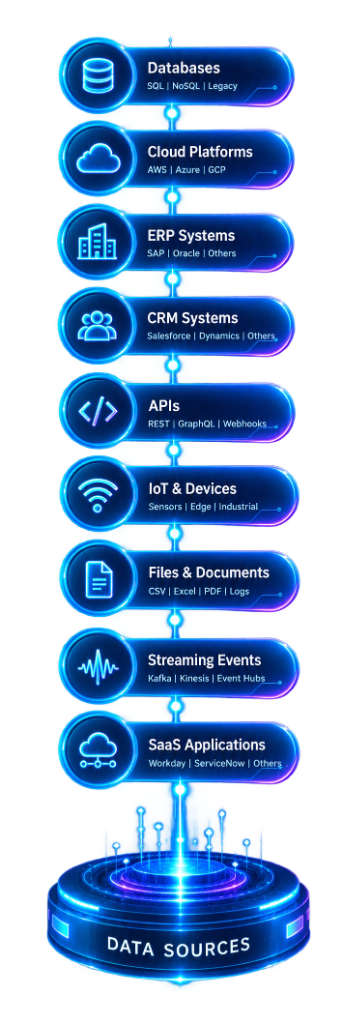
Bring all your data together

Process, govern and create trusted data

Turn data into insights

Drive decisions and real business impact


Assessing data maturity, establishing governance frameworks, and designing scalable cloud data roadmaps.
Consolidating data across disparate CRM, ERP, transactional databases, and third-party SaaS APIs.
Engineering automated batch and real-time streaming pipelines using Apache Spark, dbt, Apache Kafka, and Apache Airflow.
Building scalable storage architectures that unify structured and unstructured enterprise information.
Implementing and optimising Snowflake, Databricks, AWS Redshift, Azure Synapse, and Google BigQuery environments.
Migrating legacy on-premises databases to managed cloud lakehouses with zero data loss.
Modelling enterprise metrics and building intuitive executive dashboards in Power BI and Tableau.
Designing real-time operational analytics interfaces for monitoring business KPIs.
Implementing automated schema validation, Master Data Management (MDM), and data lineage tracking.
Structuring clean, feature-engineered datasets and vector stores to support machine learning models.
A data warehouse stores structured, curated data optimised for fast SQL reporting. A data lakehouse combines the low-cost storage and unstructured data handling of a data lake with the transactional reliability, schema enforcement, and query performance of a data warehouse.
We implement automated schema validation using tools like dbt and Great Expectations. If upstream data formats change unexpectedly, our pipelines route invalid records to a quarantine queue for review without breaking the main data flow.
Yes. We execute phased database migrations to cloud platforms such as Snowflake, Databricks, or BigQuery using automated migration scripts and continuous replication to prevent operational downtime.
We use Apache Kafka, AWS Kinesis, and Apache Spark Streaming to ingest, process, and analyse streaming event data in real time.
We implement role-based access controls, column-level masking for Personally Identifiable Information (PII), automated data lineage tracking, and audit logging to comply with GDPR, HIPAA, and SOC 2 requirements.
dbt (data build tool) brings software engineering best practices—such as modular code, version control, automated testing, and CI/CD documentation—directly to SQL data transformations.
A focused proof-of-value or single pipeline modernisation typically takes 4 to 8 weeks. Comprehensive enterprise-wide migrations are delivered in structured, multi-phase releases over 3 to 6 months.
Yes. We provide complete documentation, data dictionaries, automated pipeline runbooks, and hands-on knowledge transfer sessions for your internal engineering team.